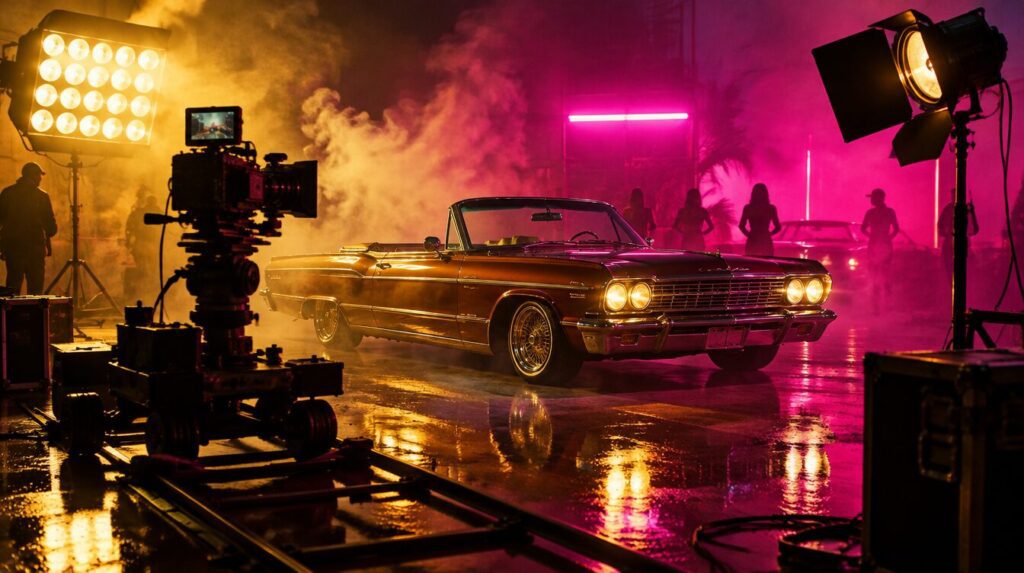
For about fifteen years the music video was the most powerful marketing tool in Black culture, and the women who carried those videos were as recognisable as the artists rapping over them. They were called vixens, a word that flattened them into scenery and gave them almost none of the credit.
This list corrects that. Every woman here converted a few minutes of screen time into a career: publishing houses, swimwear lines, fitness platforms, boutiques, podcasts, films. We list the video that made them and the business that outlasted it. Vote at the bottom.
1. Melyssa Ford
Ford wrote the template. She anchored Jay-Z and UGK’s “Big Pimpin'” in 2000, turned up as the diner waitress in Alicia Keys’ “You Don’t Know My Name” in 2003, and appeared in Usher’s “Yeah!” in 2004. Three of the decade’s biggest videos, one face.
She converted that into radio, real estate and reality television, then podcasting, with a long run co-hosting The Joe Budden Podcast and her own show built around wellness for women over forty.
Toronto, Canada. Barbadian and Norwegian-Russian heritage.
2. Karrine Steffans
More than twenty video sets, including Jay-Z’s “Hey Papi” in 2000, and then she did what nobody in that world had done: she wrote the book. Confessions of a Video Vixen became a New York Times bestseller in 2005 and gave the entire era its vocabulary.
She founded Steffans Publishing in 2008 and now works under her birth name, Elisabeth Ovesen, as an author and literary coach. HarperCollins published a twentieth-anniversary edition in 2025.
St. Thomas, US Virgin Islands.
3. Esther Baxter
One video did it. Petey Pablo’s “Freek-a-Leek” in 2004 made the Miami teenager a household face overnight, and Ludacris’ “Number One Spot”, Kanye West’s “The New Workout Plan” and Will Smith’s “Switch” all landed inside the same stretch.
She stepped away from video sets in 2007 to go to college, later took time to raise her son, and moved toward acting on her own terms.
Miami, USA. African American, Puerto Rican, Cuban, Norwegian and Indian descent.
4. Gloria Velez
Velez had a major role in Ja Rule’s “Holla Holla” in 1999, then appeared in “Big Pimpin'” and Sisqó’s “Thong Song” remix. She was never only a video presence.
She toured as a dancer with NSYNC as a teenager and co-hosted MTV2’s Video Honeys. She remains one of the era’s defining Latina faces and has since kept working in modeling, television and music.
Born in New York, raised in Florida.
5. Ki Toy Johnson
One appearance, permanently welded to Atlanta iconography. Johnson was one of the featured women in OutKast’s “The Way You Move” in 2003, Big Boi’s half of the Speakerboxxx/The Love Below double single, with Sleepy Brown on the hook.
She has kept a low public profile since.
USA.
6. Buffie Carruth
Tony Yayo and 50 Cent’s “So Seductive” in 2005 made Carruth the most-requested name on the mid-2000s magazine circuit. She walked away from urban modeling in 2012 and rebuilt from scratch in fitness.
DIY workout videos first, then her certified-trainer work, the Grade A Glutes DVD in 2013, the Bodynomics brand, and Brick Built, her apparel line. She has now spent longer coaching women on strength training than she ever spent in front of a video camera.
Georgia, USA. Known as Buffie the Body.
7. Rosa Acosta
Before the videos she danced from the age of four and, at 18, became the youngest member of the Dominican national ballet. Drake’s “Best I Ever Had” in 2009 reintroduced her to America, alongside Jamie Foxx’s “Blame It” and 50 Cent’s “Ok, You’re Right” the same year.
She financed her own exit routes: CossaMia, the online boutique that grew into a Melrose Avenue storefront, built on a bet on herself.
Santo Domingo, Dominican Republic.
8. Bernice Burgos
Burgos was a New York bartender in her mid-twenties when Rick Ross’ “Diced Pineapples” in 2012, with Wale and Drake, put her on a national screen.
What separates her is what came after. She converted early Instagram reach into actual inventory, launching the Bold & Beautiful sleepwear line and a sleepwear brand built for women of every shape and size. She stayed one of hip-hop’s most recognisable faces while building it.
New York, USA.
9. Lola Monroe
Born Fershgenet Melaku in Addis Ababa and raised in Washington DC, she worked as Angel Lola Luv on sets for Kanye West and Trey Songz, with Songz’s “Wonder Woman” in 2007 as her signature.
Then she did the rarer thing and picked up the microphone, earning a 2011 BET Award nomination for Best Female Hip Hop Artist. She now runs the accessories brand Purrsuazions and a vegan skincare line while rebuilding her catalogue.
Addis Ababa, Ethiopia and Washington DC.
10. Amber Rose
Rose broke nationally in Young Jeezy and Kanye West’s “Put On” in 2008, then Ludacris’ “What Them Girls Like”, Fabolous’ “You Be Killin’ Em” and Nicki Minaj’s “Massive Attack”. She never treated it as a cameo career.
She co-founded a clothing line in 2012, published How to Be a Bad Bitch with Simon & Schuster, founded SlutWalk LA in 2015 as an annual demonstration, and began hosting Loveline in 2016.
Philadelphia, USA. Cape Verdean and Irish-Italian heritage.
11. Vida Guerra
A December 2002 magazine feature generated so much reader mail that the publisher kept re-booking her and named her Model of the Year in 2004, a level of pull almost nobody in that lane had.
On video sets she appeared in Nelly, P. Diddy and Murphy Lee’s “Shake Ya Tailfeather” in 2003, Kanye West’s “The New Workout Plan” in 2004 and Frankie J’s “Obsession” in 2005, plus Chappelle’s Show sketches. She went on to compete, earning IFBB Bikini Pro status in 2011.
Havana, Cuba, raised in Perth Amboy, New Jersey.
12. Draya Michele
Andraya Michele Howard is the case study in turning visibility into manufacturing. Mint Swim launched in 2011, Fine Ass Girls in 2013 and Beige & Coco in 2016.
She has kept a working screen career running alongside them, from True to the Game and Star to L.A.’s Finest and recent film work, with Don Toliver’s “Cardigan” as her music video credit of record. Fewer video sets than her peers, more balance sheets.
Reading, Pennsylvania, USA.
The part nobody covered
Almost every woman on this list was written about for three or four years and then dropped by the same magazines that put her on the cover. Almost every one of them was running a company within a decade.
That is the actual story of the video era, and it is a business story. Vote below for who wore the crown.
Cast Your Vote
Who is the greatest video vixen of all time? Results update live as readers vote.