
There is regular travel and then there is the kind where the place itself is the point: somewhere the culture survived, somewhere our people bought the land when they were not allowed to swim off anyone else’s, somewhere the ancestors actually walked. This list is the second kind.
Twelve destinations, mixing Caribbean and African coastlines with the historic Black resort towns in America that most travel magazines still ignore. History, what to do, and when to go. Vote at the bottom.
1. Cape Coast and Elmina — Ghana
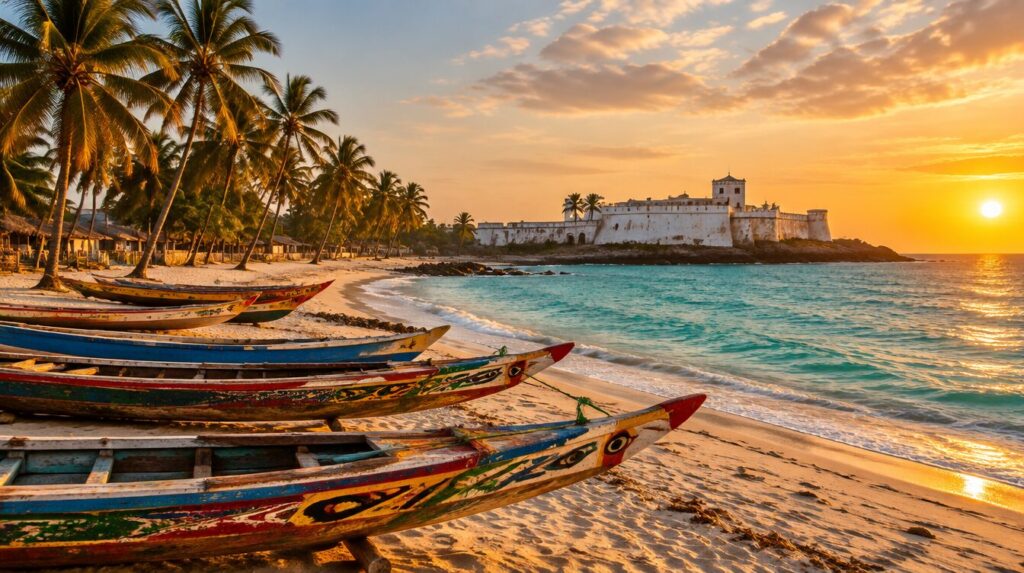
Elmina Castle was built by the Portuguese in 1482 and Cape Coast Castle followed in the seventeenth century. Both are UNESCO World Heritage Sites, and both hold the Door of No Return. This is the single most significant pilgrimage in the diaspora and it is not a comfortable day.
Go with a guide, allow the whole day, and give yourself the evening afterwards with nothing scheduled. Pair it with Kakum National Park’s canopy walkway inland, and with the fishing harbour at Elmina, which is one of the great sights in West Africa. Best in the drier months, roughly November to March.
Central Region, Ghana. Two UNESCO sites.
2. Gorée Island — Senegal
A twenty-minute ferry from Dakar to a UNESCO World Heritage Site with no cars on it. The Maison des Esclaves and its Door of No Return are the reason most people come, and the island’s scale, small, pink, quiet, makes the history land harder rather than softer.
Stay long enough to walk past the museums to the far side, where local families live an ordinary life on an island the rest of the world treats as a monument. Pair it with the Museum of Black Civilisations back in Dakar. Cooler and drier roughly November to May.
20 minutes by ferry from Dakar.
3. Zanzibar — Tanzania
Stone Town is a UNESCO World Heritage Site and one of the great Swahili cities, a coral-stone maze of carved doors, spice markets and Omani, Indian, Persian and African architecture layered on top of one another. It was also a major slave-trading port, and the Anglican cathedral built over the old slave market says so plainly.
North and east of town the beaches at Nungwi, Kendwa, Paje and Jambiani are as good as anything in the Indian Ocean, and dhow sailing at sunset is the local pastime rather than a tourist product. Best roughly June to October and December to February. Time it with Sauti za Busara, which runs 19–21 March in 2027.
Tanzania. Stone Town plus the north and east coasts.
4. Salvador and Morro de São Paulo — Bahia, Brazil
Salvador is the most African city in the Americas, where more than 80 percent of residents identify as Black or pardo, and Bahia is where candomblé, capoeira and the berimbau survived. Start in Pelourinho, find a bloco afro rehearsal, and eat acarajé from a Bahiana in white lace who has been frying it in dendê oil at the same corner for thirty years.
Then take the catamaran to Morro de São Paulo on Tinharé island, where there are no cars, the beaches are numbered, and the tempo drops about forty percent. Best roughly December to March, which is also carnival.
Bahia, Brazil. City plus island.
5. Cartagena and San Basilio de Palenque — Colombia
Cartagena’s walled city is beautiful and heavily touristed. The reason to come is about an hour inland. San Basilio de Palenque was founded by Benkos Biohó and other escaped Africans and is widely described as the first free town in the Americas, recognised by the Spanish Crown in 1691.
Its people still speak Palenquero, a Spanish-based creole found almost nowhere else, and UNESCO has listed the village’s cultural space as Intangible Cultural Heritage. Go with a community guide, not a bus tour. Dry season roughly December to April.
Colombia. Palenque is 45 minutes from Cartagena.
6. Puerto Viejo and Limón — Costa Rica
Costa Rica’s Caribbean coast is Afro-Caribbean rather than Latin American in feel, settled largely by Jamaicans who came to build the railway and work the banana trade in the nineteenth century. English-based creole, patty shops, rondón and rice and beans cooked in coconut milk.
Puerto Viejo, Cocles, Punta Uva and Manzanillo run one after another down a coast of black and gold sand backed by rainforest, with sloths in the trees above the road. Limón’s own carnival in October is the Black cultural event of the Costa Rican year. Best roughly September and October, and February to April.
Limón Province, Costa Rica.
7. Tobago
Trinidad has the carnival and the money. Tobago has the reef. It is quieter, greener and almost entirely undeveloped by Caribbean standards, and the Main Ridge Forest Reserve, protected since 1776, is often called the oldest legally protected forest reserve in the western hemisphere.
Snorkel Buccoo Reef, walk to Argyle Falls, eat curry crab and dumpling on a Sunday, and go to Sunday School in Buccoo, which despite the name is a street party that starts on Sunday night and runs into Monday. Dry season roughly January to May.
Trinidad and Tobago. The quiet island.
8. Treasure Beach and Negril — Jamaica
Negril’s seven-mile beach and the cliffs at West End are the postcard, and worth it. Treasure Beach on the south coast is the counter-argument: a string of fishing villages in St Elizabeth with almost no all-inclusives, a genuinely community-owned tourism model, and a coastline that looks nothing like the brochure.
Do both. Boat out to Pelican Bar, a driftwood shack standing on a sandbar a quarter mile out to sea, and up the coast to YS Falls. Best roughly November to April.
Jamaica. West end plus south coast.
9. Cape Verde — Sal, Boa Vista and São Vicente
Ten islands off West Africa with a creole culture entirely their own, and a musical export record that punches absurdly above the population: morna, coladeira, funaná, and Cesária Évora, the barefoot diva from Mindelo who took morna to the world.
Sal and Boa Vista have the beaches and the wind and kite surfing. São Vicente has Mindelo, the cultural capital, and its own carnival in February. Year-round, with the warmest sea roughly August to November.
West Africa, Atlantic. Beaches plus Mindelo.
10. Oak Bluffs, Martha's Vineyard — USA
Black families have summered in Oak Bluffs since the late nineteenth century, and the Highlands and the Baptist Temple Park area became one of the most storied Black vacation communities in America, home to writers, judges, doctors and, later, a sitting president on holiday.
The Inkwell is the beach that gave the community its name and its in-joke, reclaimed from an insult. Walk the gingerbread cottages of the Camp Meeting Association, get fried fish on Circuit Avenue, and go in August when the whole network is there.
Massachusetts, USA. Go in August.
11. The Gullah Geechee corridor — Sea Islands, USA
From Wilmington, North Carolina down to Jacksonville, Florida, the Sea Islands are home to the Gullah Geechee, descendants of enslaved West and Central Africans who, isolated on rice and indigo islands, kept more African language, foodways, craft and spiritual practice intact than anywhere else in the United States.
Congress designated the corridor a National Heritage Area in 2006. Visit the Penn Center on St Helena Island, one of the first schools for freed people in the South, buy sweetgrass baskets from the makers in Charleston, and eat red rice and okra soup that will explain the whole Atlantic to you. Note that land rights on Sapelo Island have been under active dispute, so check access before planning that leg. Spring and autumn are best.
North Carolina to Florida. National Heritage Area.
12. Idlewild and American Beach — USA
Two towns Black Americans built because segregation locked them out of every other resort. Idlewild, in rural Michigan, was founded in 1912 and became the most famous Black resort in the country, drawing Louis Armstrong, Della Reese, Aretha Franklin and the Du Bois circle at its peak.
American Beach on Amelia Island, Florida, was founded in 1935 by A.L. Lewis, Florida’s first Black millionaire and head of the Afro-American Life Insurance Company, so that Black Floridians could have, in the phrase used at the time, recreation and relaxation without humiliation. Both are quiet now and both are on the National Register. Go, spend money, and understand what integration cost them. Summer for Idlewild, spring or autumn for American Beach.
Michigan and Florida, USA. Historic Black resorts.
Travel notes
Check visa and entry requirements early for Ghana, Senegal, Tanzania, Brazil and Colombia, because several of them changed rules recently and a couple require proof of yellow fever vaccination.
Where a place is somebody’s home rather than a resort, and that is most of this list, hire local guides, buy from local makers and ask before you photograph anyone. In Palenque and along the Gullah Geechee corridor that is not etiquette, it is the whole reason the culture is still there to visit.
Vote below for the trip you are booking next.
Cast Your Vote
Which trip are you booking next? Results update live as readers vote.
