
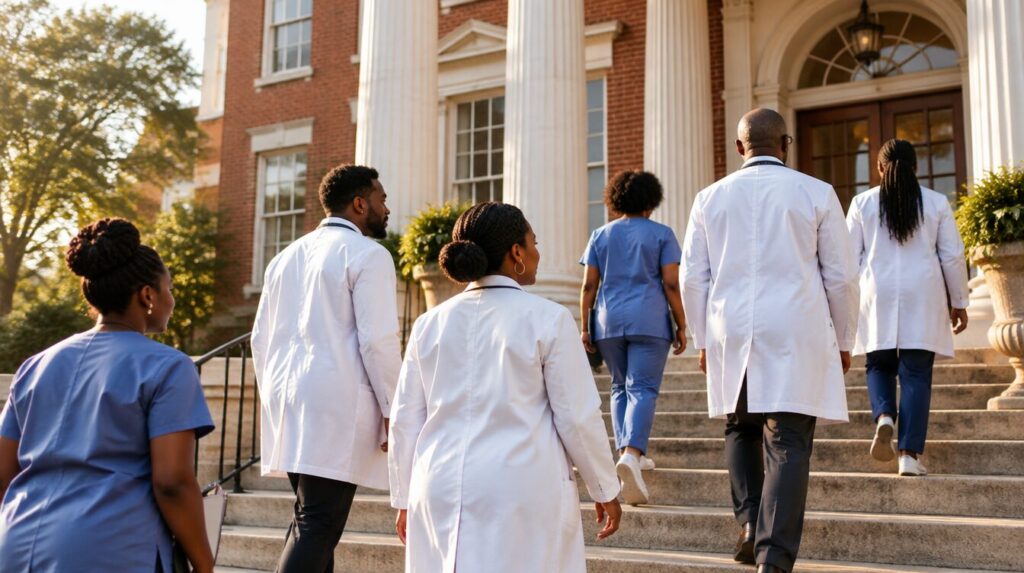
American medicine spent most of its history refusing to treat Black patients and refusing to train Black doctors. So Black people built their own hospitals. Some of them are gone. Some of them are the safety net for an entire city. All of them are the reason a Black physician had anywhere to complete a residency before 1960.
This is a list of Black-founded and Black-serving institutions, not a ranking of care quality. We name the founders, the founding years, and where each one stands today, including the ones that closed. Vote at the bottom for the legacy that deserves the biggest spotlight.
1. Provident Hospital of Cook County — Chicago, USA
The original. In 1891 Dr. Daniel Hale Williams built Provident because Emma Reynolds had been refused a nursing school seat for being Black. It became America’s first Black-owned and Black-operated hospital, and one of the first interracial hospitals, with a training school for Black nurses attached.
Two years later Williams performed one of the earliest successful pericardium repairs inside it. Provident closed under heavy debt in 1987, was bought by Cook County in 1991, reopened in 1993, and still runs today in Bronzeville.
Founded 1891. Still operating.
2. Howard University Hospital — Washington DC, USA
Chartered by Congress in 1862 as Freedmen’s Hospital, to treat people the rest of American medicine would not touch. It moved onto Howard’s campus in 1869, stayed federal until Congress handed it to the university in 1967, and opened its current Georgia Avenue building in 1975.
It remains the only teaching hospital in the country sitting on an HBCU campus, a Level 1 trauma centre and the District’s safety net. Howard has unveiled plans for a $650 million replacement hospital.
Founded 1862 as Freedmen’s Hospital. Still operating.
3. Delta Health Center — Mound Bayou, Mississippi, USA
Launched in 1967 in the all-Black town of Mound Bayou by Dr. H. Jack Geiger and Dr. Count Gibson with the organiser John Hatch, it became the first rural community health centre in America.
Staff did not just write prescriptions. They dug wells, built sanitation, and famously wrote prescriptions for food, arguing that hunger was the diagnosis. That model has been copied into roughly 1,400 community health centres now serving more than 32 million people.
Founded 1967. Still operating.
4. Meharry Medical College and Nashville General Hospital — Nashville, USA
Meharry, founded in 1876, is the largest private, independent historically Black academic health sciences centre in the country. Nashville General is the safety-net hospital that sits on its campus and trains its doctors.
The partnership nearly broke over an expired contract and a leadership shake-up, and the two sides signed a new agreement in September 2025 that gave Meharry a seat on the hospital authority board. Watch this one.
Meharry founded 1876. Still operating.
5. Morehouse School of Medicine and Grady Memorial Hospital — Atlanta, USA
Louis W. Sullivan opened a two-year medical education programme at Morehouse College in 1975. By 1981 it was an independently chartered four-year medical school, the first Black medical school founded in the twentieth century.
Most of its clinical training happens inside Grady, one of the largest public hospitals in the Southeast. A landmark national study ranked Morehouse first among all US medical schools for social mission: graduates who go into primary care, work shortage areas and come from underrepresented groups. Dr. Valerie Montgomery Rice has led it since 2014.
Founded 1975. Still operating.
6. Charles R. Drew University and MLK Community Hospital — Los Angeles, USA
The McCone Commission blamed the 1965 Watts uprising partly on the fact that South Los Angeles had almost no doctors. Charles R. Drew University was incorporated in 1966 as the answer, and groundbreaking for what became Martin Luther King Jr. General Hospital followed in 1968.
King closed in 2007 over care failures and reopened in 2015 in a new $210 million hospital. Drew won preliminary accreditation in 2022 for the first new historically Black four-year MD programme in more than forty years. MLK Community Hospital’s leadership has warned that federal Medicaid cuts put the hospital under real financial pressure.
Founded 1966. Still operating.
7. Watts Healthcare Corporation — Los Angeles, USA
Born straight out of the 1965 Watts rebellion. The South Central Multipurpose Health Services Center grew out of a volunteer clinic and opened in September 1967, with Clifton Cole as its first executive director from 1968.
It grew into a full network: House of Uhuru for substance treatment in 1969, the Watts Health Center in 1979, then a string of community clinics running primary care, dental, behavioural health, specialty and urgent care across Los Angeles County.
Founded 1967. Still operating.
8. Riverside Hospital — Houston, USA
Opened in 1926 as Houston Negro Hospital, the city’s first nonprofit hospital for Black residents, with a nursing school added in 1931. As Riverside General it anchored the Third Ward for decades before financial collapse shuttered it in 2015.
Harris County put roughly $200 million behind bringing it back, and in 2026 the restoration began bringing it back as a county public health hub: dental, immunisations, HIV and STI screening and wraparound services for housing, food and transport. It is not returning as a full acute-care hospital, but it is coming back.
Founded 1926. Closed 2015. Returning as a county health hub.
9. Flint-Goodridge Hospital — New Orleans, USA
Started in 1896 as the Phyllis Wheatley Sanitarium and Training School for Negro Nurses, founded by the New Orleans chapter of the Phyllis Wheatley Club after white hospitals turned Black patients away. It became the first Black hospital in the American South.
Under superintendent Albert Walter Dent it grew into the largest Black employer in Louisiana and ran a Penny a Day insurance plan decades before Medicaid. For Black physicians under Jim Crow it was one of the only places in the region to complete a residency. It closed in 1983 and the building on Louisiana Avenue is now apartments.
Founded 1896. Closed 1983.
10. John A. Andrew Memorial Hospital — Tuskegee, Alabama, USA
Opened in 1892 by Tuskegee Institute as its hospital and nurse training school, the first Black hospital in Alabama. Dr. John A. Kenney Sr. took it over in 1902 and turned it into a regional referral centre, one of only a handful of first-rate Southern hospitals that would treat Black patients before 1940.
It carries the darkest chapter too: the US Public Health Service’s syphilis study ran there. Drained by charity care, it closed in 1987 as the last Black hospital in Alabama. The building reopened in 1999 as the National Center for Bioethics in Research and Health Care.
Founded 1892. Closed 1987. Now a bioethics centre.
11. Korle Bu Teaching Hospital — Accra, Ghana
Opened in October 1923 with 200 beds as a hospital for indigenous Ghanaians. Its origin is colonial, but it has been Ghanaian-run since independence.
Today it carries roughly 2,000 beds, making it one of the largest hospitals in Africa and Ghana’s national referral centre, tied to the University of Ghana Medical School. Its National Cardiothoracic Centre, Reconstructive Plastic Surgery and Burns Centre and National Radiotherapy Centre pull patients from Nigeria, Togo and Burkina Faso.
Founded 1923. Still operating.
12. Chris Hani Baragwanath Academic Hospital — Soweto, South Africa
Built in 1942 as the Imperial Military Hospital for convalescing Commonwealth soldiers, then handed to Soweto’s Black population after the war. Apartheid’s segregated medicine produced, almost by accident, a giant.
Today Bara runs about 3,400 beds and nearly 7,000 staff across 170 acres, making it the largest hospital in Africa, an accredited Level 1 trauma centre and the teaching hospital for Wits Medical School. It was renamed in 1997 for Chris Hani, the SACP leader assassinated in 1993.
Founded 1942. Still operating. Largest hospital in Africa.
What the closures cost
There were well over a hundred Black hospitals in America at the peak. Integration was supposed to make them unnecessary and instead it closed most of them, taking the residencies, the nursing schools and the Black-run boards with it. Flint-Goodridge and John A. Andrew are on this list precisely because the loss is the story.
The ones still standing are carrying a load nobody else will. Vote below, then go find out who runs the safety-net hospital in your own city.
Cast Your Vote
Which Black-founded hospital's legacy deserves the biggest spotlight? Results update live as readers vote.
