Ask ten people to name the capital of the Black world and you will get ten arguments. That is the point. Blackness has never had one capital, it has had a network, and the cities on this list are the nodes that keep it running: the places where the music gets made, where the money gets banked, where the food came ashore and stayed, where the neighborhoods still carry the names of the people who built them.
We picked ten. We weighted culture, food, music, Black business density, historical weight and, honestly, the feeling you get walking the street. Every entry names a neighborhood to start in, because a city is an abstraction and a neighborhood is a place you can actually stand. Vote at the bottom for the one you would call home.
1. Lagos, Nigeria
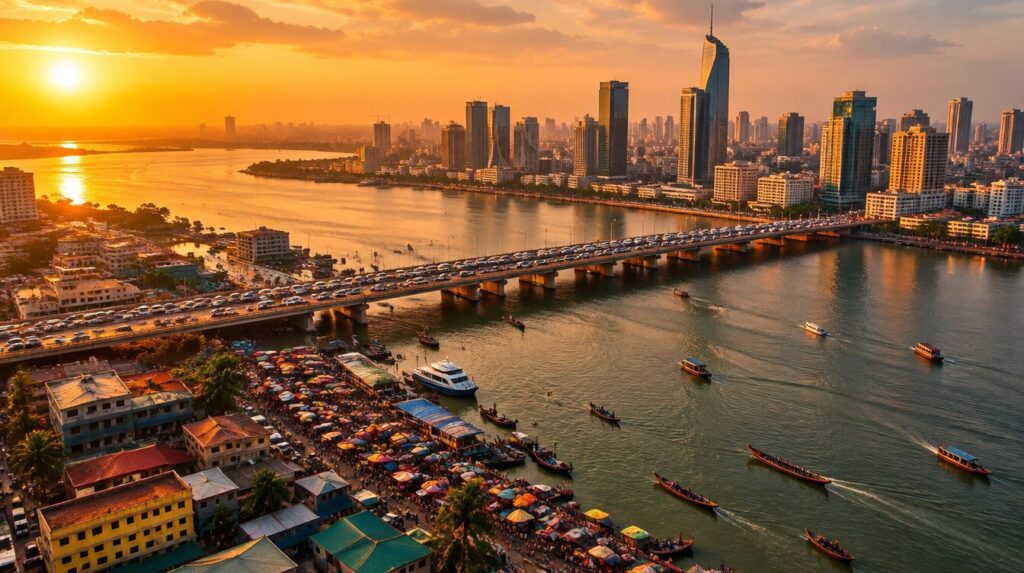
The engine room. Somewhere between 17 and 21 million people across the metro, and a creative economy that exports culture the way other countries export oil. Nollywood turns out somewhere around 2,500 films a year, second only to India by volume, and Afrobeats has made Lagos a permanent stop on the global touring circuit rather than a novelty booking.
Spend a Sunday night at the New Afrika Shrine in Ikeja, where Femi and Seun Kuti keep their father’s stage alive and the horn section does not negotiate. Then give a full morning to the Nike Art Gallery in Lekki, five floors of Nigerian painting and sculpture that would be a national museum anywhere else.
Start in: Ikeja. Art crowd: Lekki.
2. Accra, Ghana
The homecoming city. Ghana’s Year of Return in 2019 permanently rewired the relationship between the continent and the diaspora: Right of Abode grants, land purchases, whole neighborhoods of returnees who came for a festival and never bought the flight back. The tourism ministry put the economic impact at about $1.9 billion, a figure that has been fairly disputed, but nobody disputes what changed.
Every August, Chale Wote turns the colonial-era streets of Jamestown into an open-air gallery of murals, masquerade and sound systems. Do the Kwame Nkrumah Memorial Park at dusk when the light hits the mausoleum, then eat and dance your way down Oxford Street in Osu.
Start in: Jamestown (Ga Mashie).
3. Johannesburg, South Africa
Black money and Black memory in the same skyline. Henley & Partners’ 2024 Africa Wealth Report put Joburg first on the continent, with 12,300 dollar millionaires, 25 centi-millionaires and two billionaires. The soul of the city, though, is southwest.
Vilakazi Street in Soweto is the only street on earth that has housed two Nobel Peace laureates, Nelson Mandela and Desmond Tutu. Walk Mandela House first, then give the Apartheid Museum a full afternoon. It earns every minute, and you will not want to talk on the drive back.
Start in: Soweto (Orlando West).
4. Dakar, Senegal
West Africa’s intellectual capital, and it knows it. The Museum of Black Civilisations opened in December 2018 as a deliberate act of decolonisation, a $30 million home for Black history built in Africa on African terms, and TIME named it one of the World’s 100 Greatest Places the following year.
Offshore, Gorée Island is a UNESCO World Heritage Site and one of the most sobering pilgrimages anywhere in the diaspora. Go early, take the ferry, and leave time to sit. If you can time a trip around Dak’Art, the continent’s flagship contemporary art biennale, do it.
Start in: Plateau. Street life: Médina.
5. Salvador da Bahia, Brazil
The most African city in the Americas, and the census backs the poetry. Brazil’s 2022 count found 2.4 million residents in Salvador, 83.2 percent of them Black or pardo. This is where candomblé, capoeira and the berimbau survived the crossing intact.
Ilê Aiyê, founded in 1974 in the Curuzu area of Liberdade, was the first bloco afro and rebuilt Black pride in Brazil from a drumline outward. Walk Pelourinho’s cobblestones on a Tuesday night for the blessing, and if you are there before Carnival, find a bloco rehearsal. That is the real show.
Start in: Pelourinho. Blocos: Liberdade.
6. Kingston, Jamaica
One small city gave the world six genres: mento, ska, rocksteady, reggae, dub and dancehall. That is why UNESCO named Kingston a Creative City of Music in December 2015.
The Bob Marley Museum at 56 Hope Road is the obvious stop and still worth it. Trench Town Culture Yard is the real one, the government-yard tenement where Marley, Bunny Wailer and Peter Tosh learned to harmonise on a stoop. Everything you have ever heard on a soundsystem starts in that yard.
Start in: Trench Town.
7. London, United Kingdom
Black Britain’s capital. The 2021 census counted 1,188,370 Black Londoners, 13.5 percent of the city, concentrated in Lewisham, Southwark, Lambeth and Croydon. Lewisham alone is 26.8 percent Black.
Notting Hill Carnival descends from a 1959 indoor event organised by the Trinidadian activist Claudia Jones after the 1958 race riots, and it is now the largest street festival in Europe. Eat and record-shop through Brixton, then follow the Afrobeats and the jollof down Rye Lane in Peckham, which is where the West African side of the city has been living for thirty years.
Start in: Brixton. West African London: Peckham.
8. Atlanta, USA
Still the Black business capital of America. An Atlanta Regional Commission study found that 10.7 percent of businesses in metro Atlanta are Black-owned, the highest concentration of any major US metro against a national average of 3.4 percent.
Then there is the Atlanta University Center, the oldest and largest contiguous HBCU consortium in the country: Spelman, Morehouse, Clark Atlanta and Morehouse School of Medicine. Walk Sweet Auburn, once called the richest Negro street in the world, and the King Historical Park at the end of it. One note for accuracy: the city proper is no longer majority Black. The strength here is metro-wide.
Start in: Sweet Auburn.
9. New Orleans, USA
The only American city where Black people were allowed to keep the drums. Congo Square in Tremé is where enslaved Africans gathered on Sundays to trade, dance and play, and it is the direct taproot of jazz. Nothing else in American music happens without that square.
The city is still majority Black, and Tremé is among the oldest Black neighborhoods in the country. Catch a Sunday second line with a social aid and pleasure club, which is not a parade put on for you but a neighborhood institution you are welcome to walk behind. Then eat at Dooky Chase’s, the Creole dining room where the civil rights movement planned over lunch.
Start in: Tremé.
10. Houston, USA
The Black South’s boomtown, sitting inside a metro with more than a million Black residents. The Third Ward is the heart of it: Texas Southern University, Project Row Houses, and Emancipation Park, which four formerly enslaved men including the Rev. Jack Yates bought outright for $800 in 1872 so that Black Houstonians would have somewhere to hold Juneteenth.
It is the oldest park in Texas. Every June since, the city has proved the purchase was a good one. Eat your way down Almeda, then find a Screwed Up Click record and understand why Houston’s tempo is its own.
Start in: Third Ward.
The argument, continued
Ten is not enough and we know it. Kinshasa, Nairobi, Salvador’s smaller cousin Recife, Toronto, Paris, Bahia’s interior, Charlotte, Detroit, Memphis, Washington DC and Baltimore all have a case, and some of them a better one than a city we included.
So make it. Vote below, then tell us what we got wrong.
Cast Your Vote
Which city is the true capital of the Black world? Results update live as readers vote.